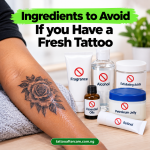
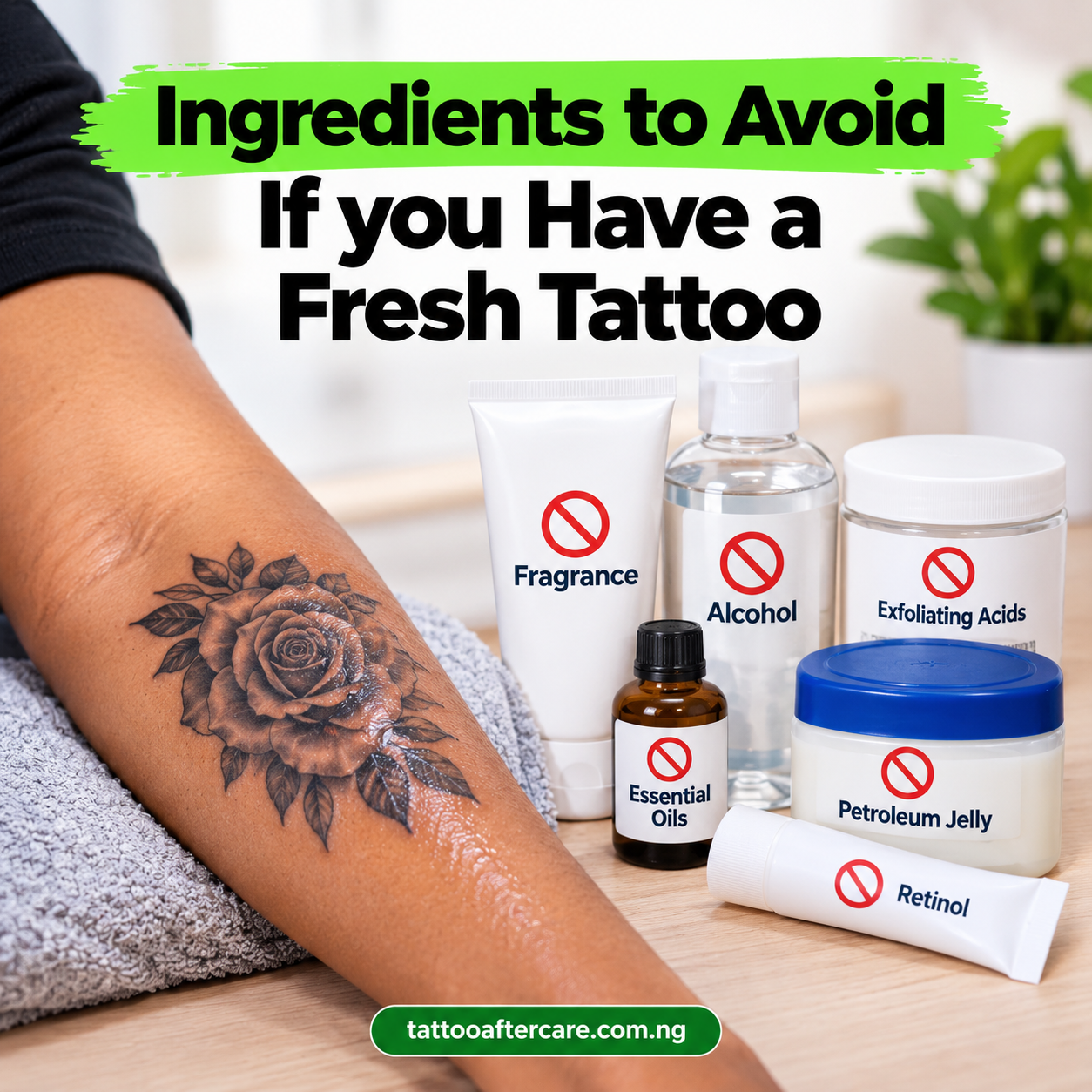
If you just got a new tattoo this are the Ingredients to Avoid If you Have a Fresh Tattoo. Alcohol-Based Products, Hydrogen Peroxide, Acids Such as Glycolic Acid and Salicylic Acid, Harsh Cleansers etc. One mistake i see most of my client make is assuming that every product labelled natural, healing, antibacterial, or moisturizing is safe for a fresh tattoo.
Your new tattoo is healing skin. During this period, some ingredients will cause irritation, dryness or allergic reactions.
So in this article i will explain the Ingredients to Avoid If you Have a Fresh Tattoo, why they cause problems, what to look for on product labels, and how to choose safer alternatives.
So, make sure you read to the end and share your experience in the comment section.
Why You Must Be Careful About What You Apply to a Fresh Tattoo
When I think about tattoo aftercare, I focus on three important things: keeping the area clean, avoiding unnecessary irritation, and allowing the skin to heal naturally.
A fresh tattoo involves tiny punctures in the skin. That means the area needs gentle care rather than a collection of strong skincare products.
Applying the wrong ingredient will cause stinging, dryness, redness or an allergic reaction. If a product irritates your skin, you may also be tempted to scratch or rub the tattoo, which can make proper healing more difficult.
The American Academy of Dermatology (AAD) recommends using a water-based lotion or cream when tattooed skin feels dry. Dermatologists also advise watching for unusual skin reactions and seeking medical care when warning signs appear.
My advice is simple: keep your tattoo aftercare routine gentle and avoid experimenting with new products while your tattoo is healing.
You can also read my guide on 7 Tips for Proper Healing of Your New Tattoo for more practical ways to protect your new ink.
1. Fragrance and Perfume
Fragrance is one of the first things I recommend checking for when choosing a product for a fresh tattoo.
Many lotions, body creams, soaps and moisturizers contain added fragrance to give them a pleasant smell. Although these products may work well on healthy skin, fragrance can irritate sensitive or healing skin and may trigger contact dermatitis in some people.
Watch out for label terms such as:
- Fragrance
- Parfum
- Perfume
- Aroma
These terms can indicate added fragrance. A product labelled “unscented” may still contain ingredients used to mask unwanted smells, so check the ingredient list when possible.
What I recommend instead: Choose a gentle, fragrance-free cleanser and a simple moisturizer suitable for healing skin. Avoid applying your favourite scented body lotion directly to the fresh tattoo until it has healed.
You do not need a product that smells good. You need one that your healing skin can tolerate.
2. Alcohol-Based Products
Alcohol appears in many skincare products, toners, sprays and antiseptic preparations. However, not all alcohol ingredients behave the same way, and their effects depend on the type of alcohol, its concentration and the product formulation.
Products containing high concentrations of drying alcohol, such as ethanol or denatured alcohol, may sting or irritate a fresh tattoo.
I would avoid using alcohol-based sprays or rubbing alcohol directly on a healing tattoo unless a healthcare professional specifically instructs you to use a particular product.
Be careful with products containing:
- Alcohol denat.
- Ethanol
- Isopropyl alcohol
These ingredients are not automatically harmful in every skincare formula, but strong alcohol preparations are not a good choice for routine tattoo moisturizing or cleaning.
What I recommend instead: Wash the tattoo gently with a mild cleanser appropriate for healing skin, following your tattoo artist’s instructions. Rinse carefully and pat the area dry with a clean towel or disposable paper towel.
Do not use harsh products simply because you think they will disinfect the tattoo better. Gentle, consistent care is more appropriate than repeatedly applying strong chemicals.
3. Hydrogen Peroxide
Hydrogen peroxide is often associated with wound cleaning, so you may think it is a good option for a fresh tattoo.
I would not use it as part of routine tattoo aftercare.
Hydrogen peroxide can irritate healing tissue. It is not necessary for ordinary daily tattoo cleaning, and repeatedly applying it may interfere with the skin’s normal healing process.
The same principle applies to harsh disinfectants that are not intended for routine use on healing skin.
What I recommend instead: Use gentle washing and follow the aftercare instructions provided by your tattoo artist. If you suspect an infection, do not try to treat it by repeatedly pouring disinfectants onto the tattoo. Seek medical advice.
A fresh tattoo needs appropriate care, not the strongest cleaning product you can find.
4. Exfoliating Acids Such as Glycolic Acid and Salicylic Acid
Exfoliating ingredients can be useful in some skincare routines, but a fresh tattoo is not the place to experiment with them.
Common exfoliating ingredients include:
- Glycolic acid
- Lactic acid
- Salicylic acid
- Other alpha-hydroxy acids (AHAs) and beta-hydroxy acids (BHAs)
These ingredients help remove dead skin cells or treat certain skin concerns. However, they may cause stinging, dryness or irritation when applied to healing skin.
I recommend avoiding chemical exfoliants directly on the tattoo until the skin has fully healed.
This also means avoiding exfoliating scrubs, peeling solutions and products designed to make your skin shed faster. So this are the Ingredients to Avoid If you Have a Fresh Tattoo.
What I recommend instead: Let the skin shed naturally. If you notice peeling or light flaking, do not try to speed up the process. Keep the area clean, moisturize appropriately and allow the healing process to continue.
If you want to use exfoliating skincare on the area later, wait until it is fully healed and reintroduce products cautiously.
5. Retinol and Other Strong Retinoids
Retinol and other topical retinoids are commonly used in skincare routines for acne, uneven skin texture and signs of ageing.
However, these ingredients can cause irritation, peeling and dryness, particularly when the skin is sensitive.
For this reason, I recommend avoiding retinol and other strong retinoid products directly on a fresh tattoo.
Look for ingredients such as:
- Retinol
- Tretinoin
- Adapalene
- Retinal or retinaldehyde
These ingredients are not all identical, and some are prescription treatments. If you already use a prescribed retinoid on or near the tattooed area, ask your prescriber when it is safe to restart.
What I recommend instead: Keep your routine simple while the tattoo heals. Avoid trying to treat the tattooed area for acne, wrinkles or pigmentation until the skin has recovered.
The priority during healing is to protect the skin barrier rather than introduce another active treatment.
6. Strong Essential Oils
Natural ingredients are not automatically safe for a fresh tattoo.
Essential oils such as tea tree, peppermint, eucalyptus and citrus oils can irritate some people’s skin, especially when concentrated or applied without suitable dilution.
Even when an ingredient has a reputation for being soothing or antibacterial, that does not mean it is appropriate for healing tattooed skin.
I would avoid applying concentrated essential oils or homemade essential-oil mixtures directly to a fresh tattoo.
Be particularly cautious with homemade blends because their strength and formulation may be difficult to judge.
What I recommend instead: Choose a simple, fragrance-free product designed for sensitive skin. You do not need essential oils to make your tattoo heal properly.
If a product causes burning, itching or increasing redness, stop using it. If the reaction is severe or continues, seek medical advice.
7. Petroleum Jelly and Heavy Occlusive Products
Petroleum jelly is a common household product, and many people use it to protect dry skin. However, it is important to distinguish between general skin care and the needs of a fresh tattoo.
The American Academy of Dermatology advises using a water-based lotion or cream for dry tattooed skin and notes that petroleum-based products may contribute to tattoo ink fading. Cleveland Clinic also advises avoiding petroleum jelly during tattoo healing.
Heavy products can create an overly occlusive layer, particularly when applied thickly or repeatedly. They may not be appropriate for your particular healing routine.
What I recommend instead: Follow your tattoo artist’s instructions for the initial dressing and aftercare. When moisturizing is appropriate, use a small amount of a suitable product rather than coating the tattoo in a thick layer.
Do not confuse “more product” with “better healing.”
For further guidance, see the American Academy of Dermatology’s tattoo-care recommendations.
8. Antibiotic Ointments Without Medical Advice
Some people believe they should apply an antibiotic ointment to every fresh tattoo to prevent infection.
I do not recommend automatically adding an antibiotic ointment to your routine without a medical reason.
Topical antibiotics, including products containing neomycin or bacitracin, can cause allergic contact dermatitis in some people. Unnecessary use can also expose your skin to ingredients it may not need.
This does not mean antibiotics should never be used. A healthcare professional may recommend a specific treatment if an infection or another medical problem requires it.
What I recommend instead: Keep the tattoo clean and follow your aftercare instructions. If you notice worsening pain, spreading redness, pus or other signs of infection, seek medical attention rather than trying different ointments yourself.
A product marketed as “antibacterial” is not automatically the right product for your tattoo.
9. Strong Soaps and Harsh Cleansers
You need to keep your new tattoo clean, but that does not mean you should use the strongest soap available.
Harsh cleansers, heavily fragranced body washes and products that leave your skin feeling tight or irritated may make aftercare more difficult.
I recommend being cautious with cleansers that contain strong fragrances, aggressive exfoliating ingredients or other components that you already know irritate your skin.
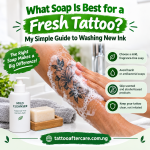
What I recommend instead: Use a gentle cleanser suitable for healing skin, wash with clean hands and rinse thoroughly. Avoid scrubbing the tattoo with a rough sponge, exfoliating glove or washcloth.
After washing, pat the area dry instead of rubbing it.
If your skin feels increasingly tight, dry or uncomfortable after using a cleanser, reconsider whether that product is suitable for your healing routine.
10. Strongly Medicated Creams and Unprescribed Steroid Products
Not every cream found in a pharmacy or medicine cabinet is suitable for a fresh tattoo.
Steroid creams, antifungal preparations and other medicated products are designed for specific conditions. Using them without knowing what problem you are treating may irritate the skin or delay appropriate care.
For example, topical corticosteroids can be useful for certain inflammatory skin conditions, but they should not be used routinely on a fresh tattoo unless a qualified healthcare professional advises you to do so.
What I recommend instead: Avoid experimenting with medicated creams when the tattoo is healing normally. If you develop a persistent rash, severe itching or unusual swelling, ask a healthcare professional to assess the problem and recommend appropriate treatment.
Do not assume that every rash is an infection, and do not assume that every rash can be fixed with a steroid cream.
What Ingredients Should I Look for in Tattoo Aftercare Products?
After learning what to avoid, you may be wondering what you should use instead.
I recommend starting with a simple product rather than buying several specialised creams.
When choosing a cleanser or moisturizer, look for these qualities:
- Fragrance-free: This can help reduce exposure to a common source of skin irritation.
- Gentle formulation: Choose a product suitable for sensitive or healing skin.
- Water-based moisturizer: The American Academy of Dermatology recommends a water-based lotion or cream for dry tattooed skin.
- Simple ingredient list: Fewer unnecessary extras make it easier to identify a product that irritates you.
- Suitable for your healing stage: Follow the instructions for your tattoo dressing and the product you intend to use.
There is no single product that works perfectly for everyone. Your skin type, allergies, tattoo location and dressing method can all affect which products are appropriate.
If you have a history of eczema, contact dermatitis or reactions to skincare products, consider asking a healthcare professional for personalized advice. Make sure Ingredients to Avoid If you Have a Fresh Tattoo is well noted in your daily.
How I Would Keep My Tattoo Aftercare Routine Simple
If I were putting together a basic tattoo aftercare routine, I would focus on consistency rather than buying every product marketed for tattoos.
Step 1: Follow the dressing instructions
Keep the initial dressing on for the period recommended by your tattoo artist or the dressing manufacturer. Different dressings have different instructions, so do not assume that every tattoo should be unwrapped at the same time.
Step 2: Wash gently
When it is time to clean the tattoo, wash your hands first. Clean the area gently according to your artist’s instructions, and avoid scrubbing or using harsh products.
Step 3: Dry without rubbing
Use a clean towel or disposable paper towel to pat the area dry. Rubbing can irritate healing skin.
Step 4: Moisturize appropriately
When your aftercare instructions call for moisturizing, apply a thin layer of a suitable product. Avoid repeatedly adding more cream just because the tattoo feels tight or looks flaky.
Step 5: Avoid unnecessary products
Do not add perfume, exfoliating acids, retinoids, essential oils or unprescribed medicated creams to the healing area.
Step 6: Monitor how your skin responds
Mild soreness, some redness, itching and peeling can occur during normal healing. However, symptoms should generally improve rather than become progressively worse.
For a more detailed routine, read my guide to Tattoo Aftercare: The Complete Guide.
Common Tattoo Aftercare Mistakes I Want You to Avoid
Even when you know which ingredients to avoid, a few common mistakes can still make your routine less effective.
Using too many products at once: If you apply several new products together and develop a reaction, it becomes harder to identify the cause.
Assuming natural means safe: Essential oils and plant extracts can still irritate the skin or trigger allergies.
Applying a thick layer of moisturizer: More cream is not necessarily better. Follow the product instructions and your artist’s aftercare guidance.
Picking peeling skin: Do not pull off flakes or scabs. Allow them to come away naturally.
Using home remedies without checking them: Avoid applying household mixtures, concentrated oils or harsh substances simply because someone recommends them online.
Ignoring worsening symptoms: Increasing pain, spreading redness, pus or fever should not be treated as ordinary healing.
My advice is to avoid unnecessary experimentation. A simple routine is easier to follow and makes it easier to notice when something is not working.
How Do I Know If a Product Is Irritating My Fresh Tattoo?
A product reaction can cause itching, burning, redness, swelling, a rash or small bumps. These symptoms may overlap with other skin problems, so you should not assume that every reaction is caused by a particular ingredient.
If you suspect a product is irritating your tattoo:
- Stop applying the suspected product.
- Avoid adding other new products in an attempt to counteract the reaction.
- Continue only with gentle aftercare that you know is appropriate for your healing stage.
- Seek medical advice if the reaction persists, spreads or becomes uncomfortable.
Get prompt medical attention if you experience worsening pain, redness that spreads or intensifies, increasing swelling, pus, open sores, fever or chills. Seek emergency care if you develop serious symptoms such as difficulty breathing or rapidly worsening swelling.
The American Academy of Dermatology provides further guidance on tattoo-related skin reactions.
Frequently Asked Questions About Ingredients to Avoid on a Fresh Tattoo
Can I use Vaseline on a fresh tattoo?
I would not use petroleum jelly as a routine moisturizer on a healing tattoo unless your specific aftercare instructions recommend a product for that purpose. Dermatology guidance recommends water-based lotion or cream for dry tattooed skin and cautions against petroleum-based products during healing.
Can I use coconut oil on a fresh tattoo?
I would avoid experimenting with coconut oil on a fresh tattoo unless your tattoo artist or healthcare professional has advised you to use a particular product. Natural oils can affect people differently, and a product being natural does not guarantee that it will be suitable for healing skin.
Can I apply scented lotion to my new tattoo?
It is better to choose a fragrance-free moisturizer while your tattoo heals. Added fragrance may irritate sensitive skin or trigger a reaction in some people.
Is antibacterial soap good for tattoo aftercare?
You do not automatically need a strong antibacterial soap for routine tattoo care. A gentle cleanser suitable for healing skin is generally a better starting point. Follow your tattoo artist’s instructions and seek medical advice if you suspect an infection.
Can I use aloe vera gel on a fresh tattoo?
I would be cautious about applying aloe vera gel unless the particular product is appropriate for healing skin. Some formulas contain fragrance, alcohol or other added ingredients that may irritate the area. A simple, fragrance-free product recommended for your healing routine is a more predictable choice.
How long should I avoid strong skincare ingredients?
Avoid applying exfoliating acids, retinoids and other potentially irritating active products directly to the tattoo until the skin has fully healed. Healing time varies depending on the tattoo, its location and your skin. If you are unsure whether the area has healed, ask your tattoo artist or a healthcare professional before restarting those products.
Should I stop moisturizing if my tattoo starts peeling?
Not necessarily. Peeling can be a normal part of healing. Follow your aftercare instructions and use an appropriate moisturizer if recommended, but do not apply excessive amounts or pull off the peeling skin.
Final Thoughts About Ingredients to Avoid If you Have a Fresh Tattoo
When it comes to tattoo aftercare, I believe one of the smartest decisions you can make is to stop treating a fresh tattoo like ordinary, fully healed skin.
Fragrance, harsh cleansers, exfoliating acids, retinoids, concentrated essential oils and unprescribed medicated products can create unnecessary problems for some people. Petroleum jelly and sunscreen also require careful consideration during the healing stage.
You do not need a complicated collection of products to care for a new tattoo. You need a gentle routine, appropriate aftercare instructions and the patience to let your skin heal.
Before applying anything new, read the label and think about whether the product is genuinely necessary. If you notice an unusual reaction, stop using the suspected product and seek medical advice when needed.
For more practical advice, explore these guides on my website:
- 7 Tips for Proper Healing of Your New Tattoo
- How to Sleep With a Fresh Tattoo Without Damaging It
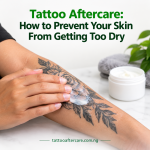
- Tattoo Aftercare: How to Prevent Your Skin From Getting Too Dry
My final advice: If you are unsure about an ingredient, do not rush to apply it to your fresh tattoo. Check the label, follow reliable aftercare guidance and ask a qualified professional when necessary. Protecting your healing skin now can help you avoid unnecessary irritation and give your tattoo the best chance to heal well. So guys this are the Ingredients to Avoid If you Have a Fresh Tattoo.