
In my last post tattoo Aftercare: The Complete Guide to Healing a New Tattoo i saw so many people asking How to Sleep With a Fresh Tattoo Without Damaging It and i want to reply those questions by writing this article.
I always remind us that a fresh tattoo is not just a piece of artwork sitting on your skin. Your skin has just gone through a controlled injury, and it needs time and proper care to heal.
One of the easiest ways to protect your new tattoo at night is to reduce unnecessary pressure, friction, heat, sweat and contact with dirty surfaces. And this is How to Sleep With a Fresh Tattoo Without Damaging It. There is no other way more than that.
So, my answer to this question is:
Sleep in a position that keeps your tattoo from being pressed against your mattress or body, keep your bedding clean, wear loose clothing when appropriate, and avoid scratching or picking the tattoo during the healing process.
Why Sleeping Can Be a Problem for a New Tattoo
When you think about tattoo aftercare, don’t only think about what products I put on the tattoo.
Think about what happens to the tattoo for the eight or so hours your sleeping.
During sleep, you can move without realizing it. My tattoo can rub against my bedsheet, pillow, mattress or clothing. I can also sweat, especially when the weather is hot.
If any of this happens it can irritate freshly tattooed skin.
A tattoo is created by repeatedly puncturing the skin and depositing pigment beneath its surface. Because the procedure damages the skin, proper aftercare matters during the healing period. Even Cleveland Clinic describes tattoos as a controlled form of trauma to the skin and notes that poor aftercare can contribute to problems such as infection, irritation and scarring.
How to Sleep With a Fresh Tattoo Without Damaging It
If you want your tattoo to remain clean and healthy make sure you following this procedures:
Follow Your Tattoo Artist’s Instructions About the Bandage
If your tattoo artist covered your tattoo with a professional dressing, don’t remove it simply because you’re going to bed unless the artist’s instructions tell you to.
Different tattoo artists use different types of coverings, and the recommended wearing time can vary.
For example, at tattooaftercare.com.ng we use transparent adhesive tattoo films, while others use different types of dressings. Cleveland Clinic also recommends following the artist’s instructions regarding how long the initial covering should remain in place.
So don’t assume that removing the covering immediately is always the right thing to do.
If you’re not sure, contact your tattoo artist and ask exactly how they want you to handle the dressing that night.
What I would not do
Keep Your Bedding Clean
This is one of the most overlooked parts of tattoo aftercare. Think about where your fresh tattoo is going to spend several hours.
Your bed. If your tattoo touches your sheets throughout the night, keeping those sheets clean makes sense.
Before sleeping with a fresh tattoo, I recommend using clean bedding and making sure the area where the tattoo will rest is free from obvious dirt, sweat, pet hair and other debris.
You don’t need to turn your bedroom into a hospital. Just use common sense.
Avoid Sleeping Directly on the Tattoo
If I have a fresh tattoo on my shoulder, chest, back, thigh or another area that touches the mattress, try to position my body so that I am not putting prolonged pressure directly on the tattoo.
Avoid anything that will cause friction, you know, every time you move against the bedsheet, you’re creating rubbing between the healing skin and the fabric.
Try changing your sleeping position
If your new tattoo is on your back, sleeping on your stomach or side may help keep direct pressure away from it.
If your tattoo is on your chest, I may choose a position that avoids pressing the tattoo into the mattress.
If the tattoo is on one side of my body, I can sleep on the opposite side.
Wear Loose, Breathable Clothing
Tight clothing can create unnecessary rubbing over a fresh tattoo. That’s why I prefer loose clothing around a healing tattoo, especially at night.
Cleveland Clinic specifically recommends loose clothing during tattoo healing because breathable clothing can reduce sticking and rubbing against the tattoo.
For example, if I have a new tattoo on my thigh, I wouldn’t choose tight trousers to sleep in.
If I have a tattoo on my shoulder or arm, I’d rather wear something loose enough that the fabric doesn’t constantly drag across the tattoo.
You don’t need expensive clothing. You simply need something clean, comfortable and loose enough to avoid unnecessary friction.
Don’t Go to Bed With a Dirty or Sweaty Tattoo
Your bedtime routine matters. If have spent the day sweating, I don’t simply jump into bed without thinking about the tattoo. I follow the cleaning instructions given by my tattoo artist.
For general tattoo aftercare, dermatology guidance recommends gently washing the tattoo with mild, fragrance-free soap and warm water rather than scrubbing it. Cleveland Clinic recommends gentle washing and patting the tattoo dry with a clean paper towel.
The important word here is gently. I don’t scrub a fresh tattoo.
I don’t attack it with a rough towel. I don’t scratch it because it feels itchy. And I don’t keep washing it repeatedly because I’m afraid of infection.
I clean it properly, dry it gently and follow the aftercare routine. For a complete overview of the healing process, you can also read my guide on 7 Tips for Proper Healing of Your New Tattoo.
Don’t Scratch Your Tattoo in Your Sleep
This one is difficult because you can’t completely control what you do while sleeping.
As the tattoo heals, itching and peeling can occur. These symptoms can be part of the normal healing process.
The problem is that scratching can irritate the skin and potentially damage the healing area.
This is what you should do before going to bed:
- Keep your fingernails clean and trimmed.
- Complete your normal aftercare routine.
- Avoid irritating products that make the skin itch.
- Don’t pick at peeling skin or scabs.
- Keep the sleeping environment comfortable so you’re less likely to become excessively sweaty.
If you occasionally wake up and realize you’ve touched the tattoo, don’t panic. Simply return to your normal aftercare routine.
Don’t Wrap Your Tattoo Just Because You’re Afraid of Your Sheets
This is an important distinction. Some people become so worried about their bedsheets touching their tattoo that they start improvising with plastic wrap, cling film or other coverings.
I wouldn’t do that without professional instructions. If your tattoo artist gave you a specific dressing and instructions for using it, follow those instructions.
Otherwise, don’t assume that wrapping a tattoo overnight automatically makes it safer.
The objective of tattoo aftercare isn’t to suffocate the tattoo. It’s to keep the healing area clean, protected and appropriately cared for.
How Long Do I Need to Be Careful While Sleeping?
There isn’t one exact number of nights that applies to every tattoo.
Healing varies depending on the tattoo’s size, location and other individual factors. Cleveland Clinic notes that the surface of a tattoo may appear healed after several weeks, while deeper layers of skin can continue healing for longer.
That’s why I don’t use a strict “after X nights you’re completely safe” rule. Instead, I pay attention to how the tattoo is healing.
During the early stage, I’m especially careful about:
- Pressure
- Friction
- Scratching
- Sweat
- Dirty bedding
- Tight clothing
- Picking at scabs or peeling skin
As the skin settles and the tattoo heals, these concerns generally become less important.
What Is Normal When I Wake Up?
A healing tattoo can look different from one day to the next.
You will notice:
- Mild redness
- Some soreness
- Itching
- Peeling
- Flaking
- Small amounts of clear fluid
- Scabbing
These can occur during normal healing. The key is to watch the direction things are going.
If irritation and redness gradually improve, that’s reassuring. If pain becomes worse, redness spreads, swelling increases, pus develops, or you develop fever or chills, don’t simply assume it’s normal tattoo healing. This is basically How to Sleep With a Fresh Tattoo Without Damaging It.
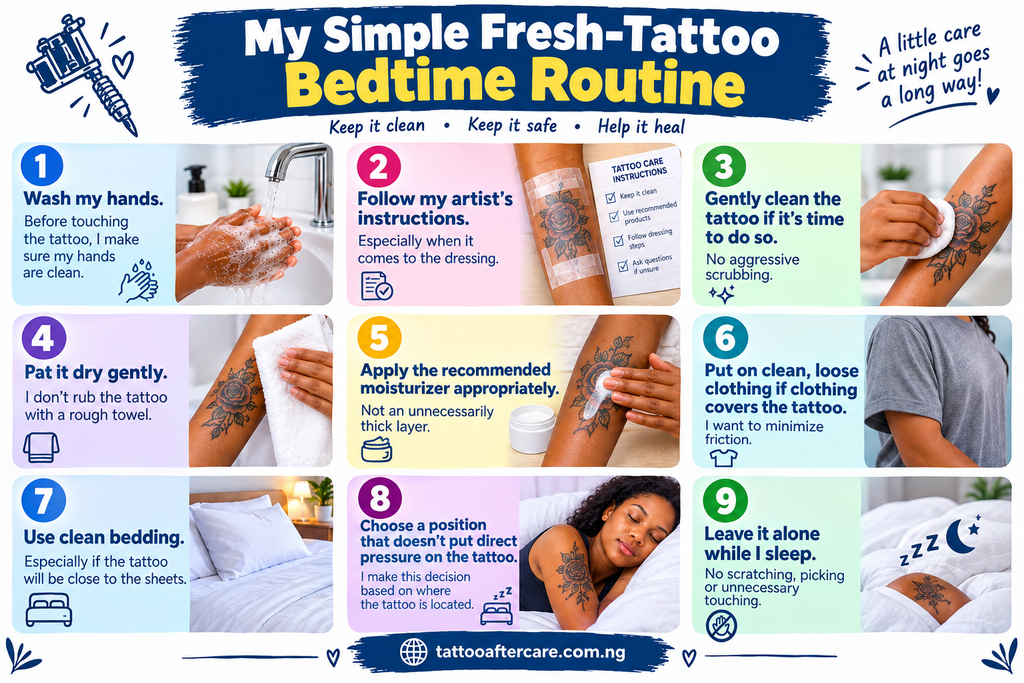
My Simple Fresh-Tattoo Bedtime Routine
If I had to simplify everything in this article into one routine, this is what I’d do:
1. Wash my hands.
Before touching the tattoo, I make sure my hands are clean.
2. Follow my artist’s instructions.
Especially when it comes to the dressing.
3. Gently clean the tattoo if it’s time to do so.
No aggressive scrubbing.
4. Pat it dry gently.
I don’t rub the tattoo with a rough towel.
5. Apply the recommended moisturizer appropriately.
Not an unnecessarily thick layer.
6. Put on clean, loose clothing if clothing covers the tattoo.
I want to minimize friction.
7. Use clean bedding.
Especially if the tattoo will be close to the sheets.
8. Choose a position that doesn’t put direct pressure on the tattoo.
I make this decision based on where the tattoo is located.
9. Leave it alone while I sleep.
No scratching, picking or unnecessary touching. This is the How to Sleep With a Fresh Tattoo Without Damaging It.
Common Mistakes You Should Avoid
When you’re worried about your new tattoo, it’s easy to overdo things.
Here are some mistakes I’d avoid:
Sleeping directly on the tattoo
Constant pressure and friction aren’t what I want during healing.
Wearing tight clothes
Tight fabric can rub against the tattoo and irritate the skin.
Using dirty bedding
If your tattoo is touching your sheets all night, clean bedding is a simple precaution.
Scratching peeling skin
Peeling can be part of healing. Picking at it isn’t helpful.
Applying excessive products
More moisturizer doesn’t automatically mean better healing.
Covering the tattoo without instructions
Don’t improvise a dressing because you’re afraid of your bedsheets.
Ignoring worsening symptoms
A tattoo can be sore while healing, but worsening pain, spreading redness, pus, fever or chills deserve medical attention.
The Bottom Line on How to Sleep With a Fresh Tattoo Without Damaging It
Let Your Tattoo Rest While You Sleep. You don’t need to be terrified of sleeping with a new tattoo.
Keep the tattoo clean according to your aftercare instructions. Keep your bedding clean. Avoid unnecessary pressure and friction. Wear loose clothing where appropriate. Don’t scratch or pick the tattoo. And follow the instructions your tattoo artist gave you for the specific dressing and products they used.
I have found that the best tattoo aftercare is not about doing something extreme.
It’s about doing the simple things consistently. Your tattoo has already gone through the hard part.
Now give your skin the time and conditions it needs to heal.
And if you’re looking for a broader routine, start with my guide to 7 Tips for Proper Healing of Your New Tattoo and build your daily aftercare routine from there.
Final Reminder
If you notice worsening pain, spreading redness, increasing swelling, pus, fever, chills or other signs of infection, don’t try to solve the problem with more tattoo products. Speak with a healthcare professional promptly.
A beautiful tattoo starts with good artwork, but keeping it healthy requires good aftercare too.
Also Check
7 Tips for Proper Healing of Your New Tattoo
Ambition Ninja Wireless Tattoo Pen Machine – Dual Battery Review: Is It Worth Buying?







One response to “How to Sleep With a Fresh Tattoo Without Damaging It”
[…] recent article, How to Sleep With a Fresh Tattoo Without Damaging It, explains how I approach pressure, bedding, clothing and friction while […]